


Rules & Regulations
Rules & Regulations
Ready to head out to the lake?
Not so fast! There are some things you need to go over before hitting the water.
Explore the subjects below to learn about Utah boating rules, regulations, and safety tips!
Life Jackets Save Lives! 
Utah Law requires all boats have at least one properly sized and serviceable U.S. Coast Guard (USCG) approved life jacket for each person on board.
All life jackets must be:
- USCG approved, in good serviceable condition, and readily accessible.
- Fitted and sized properly according to age, weight, activity, and use restrictions listed on the U.S. Coast Guard approval label.
- Passengers, 12 years-old and younger must wear a properly sized USCG-approved life jacket whenever a boat is in operation.
If you plan to wear an inflatable life jacket, read the approval label for age, use restrictions and proper care. Inflatable life jackets may not be used by person under the age of 16; when operating or riding on a PWC; when being towed behind a vessel; or while boating on rivers.
Life Jacket Requirements You Need To Know
- Boat Size and Life Jacket Requirements. Boats 16 – 39 feet in length must carry at least one throwable PFD: vessels 40 feet and greater must carry at least two throwable PFDs.
- Water Skis & PWC. Each person being towed on water skis or other devices – or operating or riding on a PWC – must wear a properly sized and USCG-approved life jacket.
- On Rivers. Every person on any vessel including inner tubes must wear a properly sized and USCG-approved life jacket.
Visit our life jackets page to learn more about life jackets!
Visit our required equipment page to learn more about what needs to be brought onboard a boat!
Boating Registration & Insurance
If your boat has a motor (gas or electric) on it, or if it is a sailboat, it needs to be registered and numbered. If you are visiting Utah (less than 60 days in a calendar year) and your boat is currently registered in your state, you do not need a Utah registration. The certificate of registration is required onboard and available for inspection by any law enforcement officer whenever the vessel is in operation.
Each motorboat and personal watercraft (PWC) is required to carry the owner’s or operator’s liability insurance when operated on Utah waters. The minimum insurance requirements are: $25,000-/$50,000 bodily injury/death – $15,000 property damage or $65,000 combined minimum per accident. Motorboats equipped with engines less than 50 horsepower and all airboats are exempt from this requirement.
Visit our Boating Registration & Insurance page to learn more.
Education
GET REAL. GET EDUCATED. GET CERTIFIED.
Learn the Ropes. Take a Course.
Utah requires a mandatory youth certification course for Personal Watercraft (PWC).
Additional education for all ages is highly recommended. Know before you go.

Don't Drink & Drive - Boating DUI
Boating under the influence (BUI) has the same limits (0.05 BAC) and carries the same legal weight as driving under the influence (DUI). The same penalties apply, including suspension of driver’s license, possible jail time, and fines.
It is against the law for a person under the influence of alcohol, drugs, or medication to operate a motorboat. Prescription and over-the-counter medications are only permitted if they do not impair your ability to safely operate the vessel, such as slowing your reaction time or affecting coordination, and judgement.
While alcohol is permitted onboard for passengers, open containers cannot be kept within arm’s reach of the operator.
A person operating a motorboat on Utah’s waters is considered to have given implied consent to any field sobriety tests requested by an officer who suspects the person in operation is under the influence of alcohol and/or drugs. If arrested, your boat, trailer, and tow vehicle may be impounded.
Please Drink Responsibly!

Speed & Proximity
Yes, there are speed limits on the water.
A wakeless or idle speed is required when operating a boat:
- In any designated slow, wakeless speed area.
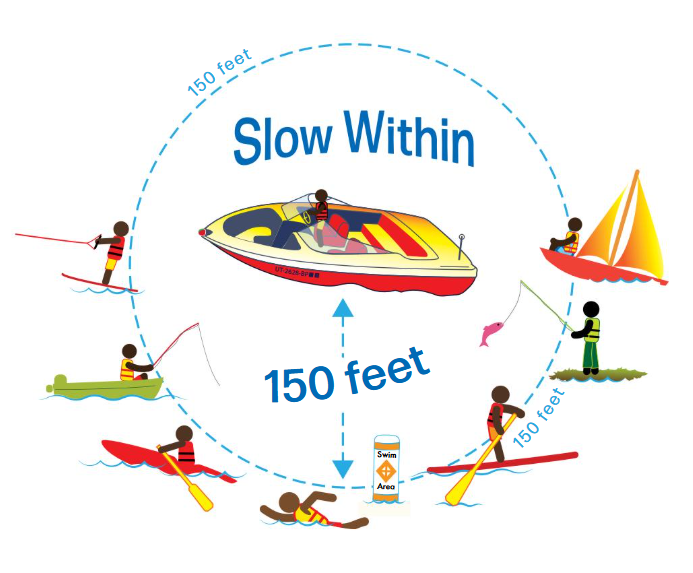
- Within 150 feet of another boat or vessel, person in the water, a water skier (except those you are towing), shore angler/fisherman, launch ramp, dock, or designated swimming area.
You are responsible for any injury or damage caused by your boat’s wake. Be courteous and give others plenty of room.
The operator must stay alert and maintain a proper lookout by both sight and hearing at all times. Always operate at a safe speed appropriate for the water, weather, and traffic conditions to give yourself enough time and space to avoid hazards and collisions. Boats do not have brakes!
Right of Way
A boat operator is required to keep a proper lookout by sight and hearing at all times. This means operating at a safe speed and distance so as to have adequate time and distance to avoid a collision with another boat or object.
Avoid collisions even if you have the right of way and know when to give way.
Meeting Head to Head
When meeting another motorboat head-on, each boat should change its course to the right (starboard side).
Both motorboats must alter its course and speed if necessary.

Crossing
When two motorboats are crossing paths, the boat on the left (give-way boat*) must slow down and alter its course to allow the other boat (stand-on boat*) to pass.
* The give-way boat must alter course and speed
* The stand-on boat maintains course and speed

Overtaking Another Boat
When passing from the rear, the boat being passed is the stand-on vessel and has the right of way. The passing boat is the give-way vessel and is required to alter its course if necessary and stay at least 150 feet away.

In narrow channels, boats underway must stay as far to the right of the middle of the channel as is safely navigable. Motorboats must slow to a wakeless speed if they cannot stay at least 150 feet away from other boats.
Motorboats should stay clear of sailboats and manually powered boats, and should not create a wake that may cause them trouble. Sailboats and manually powered boats must yield right of way when overtaking motorboats and when a motorboat is adrift or at anchor.
On rivers, boats downstream usually have the right of way over boats going upstream.
Maneuvering and Warning Signals
- 1 Short Blast - Sound 1 short horn blast to signal to another boat that you intend to pass/overtake them on their starboard side (your port side).
- 2 Short Blasts - Sound 2 short horn blasts to signal to another boat that you intend to pass/overtake them on their port side (your starboard side).
- 5 Short Blasts - Sound 5 short, rapid horn blasts if another boat's intentions are unclear, or the other boat does not seem to be taking action to avoid a collision.
Navigation Lights
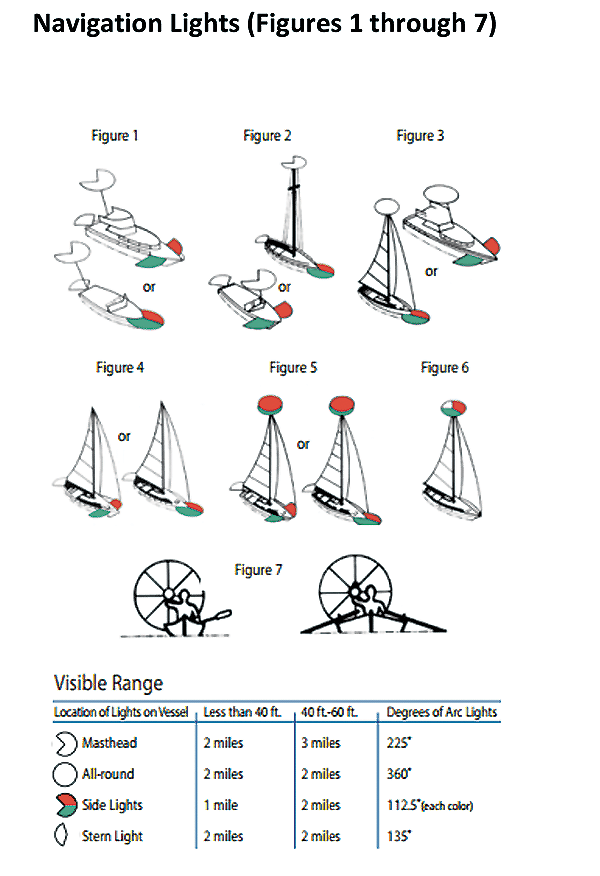
All boats must display navigation lights while operating between sunset and sunrise.
Motorboats less than 40 feet must display navigation lights as shown in figures 1, 2, or 3. Motorboats 40 to 65 feet long must display navigation lights as shown in figures 1 or 2.
Sailboats must display navigation lights as shown in figures 4, 5, or 6. Sailboats under power must follow motorboat navigation light requirements.
Manually Propelled Boats may display either navigation lights required for sailboats, or a white light (flashlight or lantern) that shall be displayed in sufficient time to prevent a collision (See figure 7).
Personal Watercraft (Jet Skis, Waverunners, Sea-Doos, etc.) may not be operated between sunset and sunrise. They may not be equipped with navigation lights.
Motorboats or Sailboats Adrift or at Anchor must display an all-round white light unless anchored in a designated mooring area.
Non-navigation lights may only be displayed under 3 conditions:
- A spotlight or other non-navigational light may be used intermittently during docking or to locate a hazard
- During a federal or state-permitted marine parade
- A spotlight or other non-navigational light may be used when actively engaged in fishing, bow fishing, or scientific research on board boats that are not in a navigational channel and that are being operated at a wakeless speed.
Passenger Seating
No one may operate a motorboat faster than a wakeless speed with passengers sitting on the bow decking, gunwales, seatbacks, or motor cover.
A person may ride on the bow decking if they do not block the view of the operator and they are straddling one of the uprights on the bow railing.

Towing People Behind the Boat
When towing water skis, wakeboards, or other devices, boat operators must maintain a safe course to ensure safety. Remember, in addition to the boat operator, you must also have an observer – at least 8-years-old – on board to watch and communicate with the skier.
The observer must also display a 12″ x 12″ orange flag when the tow is finished, or preparing to begin. Always watch your skier!
Towing is allowed only between sunrise and sunset, so no night towing. All persons being towed must wear a properly sized life jacket. It is prohibited to tow a person in a non-standing position withing 20 feet of the back of the boat.
Remember, the person being towed also counts towards your maximum person capacity, so don’t go over.

Utah Watercraft Restrictions
Anglers should check with local, state, and federal agencies regarding any and all watercraft restrictions.
The official watercraft restriction list and more information can be found in the link below:
Weather Watch
Weather can change rapidly in Utah.
Always be sure to check the weather forecast before heading out.
Be sure to pay attention to changing conditions while on the water. Remember, lighting and high winds can be bad news.

Carbon Monoxide & Propeller Injury
Do not allow anyone to spend time on the back of the boat while the engine is running!
Carbon Monoxide is known as the silent killer. This gas is odorless and tasteless. It can deplete your oxygen to the point of death.
Symptoms include
- Dull headache.
- Weakness.
- Dizziness.
- Nausea or vomiting.
- Shortness of breath.
- Confusion.
- Blurred vision.
- Loss of consciousness.

Propeller Injury. Avoid severe and potentially deadly injuries and turn your engine off when people are in the water near the boat’s propeller.
If your boat is equipped with an engine cut-off switch lanyard, please ensure it is attached to the operator.

Help! There's An Accident!
Do you know what to do in case of a boating accident?
If involved in a boating accident, stay calm and do the following:
- Help other people in the accident to the extent you are able.
- Exchange contact information with any injured person or owner of property damaged.
- Notify law enforcement immediately if anyone dies, disappears, requires treatment beyond simple first-aid, or combined property damage exceeds $2,000.
- Do not leave the scene before rendering aid, exchanging information, and notifying local law enforcement. leaving the scene of an accident is illegal.
- Submit an Accident Report. Complete and sign boat owner/operator accident report form and submit it to Utah State Parks within 10 days. Forms are available from a park ranger or at boating.utah.gov.


RESOURCES
CONTACT US
General Questions
(801) 538-5500
[email protected]
Address
1594 W North Temple
Suite 100
Salt Lake City, UT 84116
ADDITIONAL RULES & REGULATIONS RESOURCES
Boating Registration and Insurance
Required Equipment Checklist
Utah's Boating Law Highlights
Utah's Boating Laws & Rules - Complete List
The monthly newsletter keeps you updated on Utah’s outdoor community, industry, events, jobs, stewardship opportunities, and more.
Stay up to date on Utah’s outdoor community by signing up here.